
Blog
What is hybrid mail, and when does it make sense for your business?
Hybrid mail replaces in-house printing, stuffing, and post office trips with digital upload and professional UK production. Here's when it makes sense, when it doesn't, and what to look for in a provider.
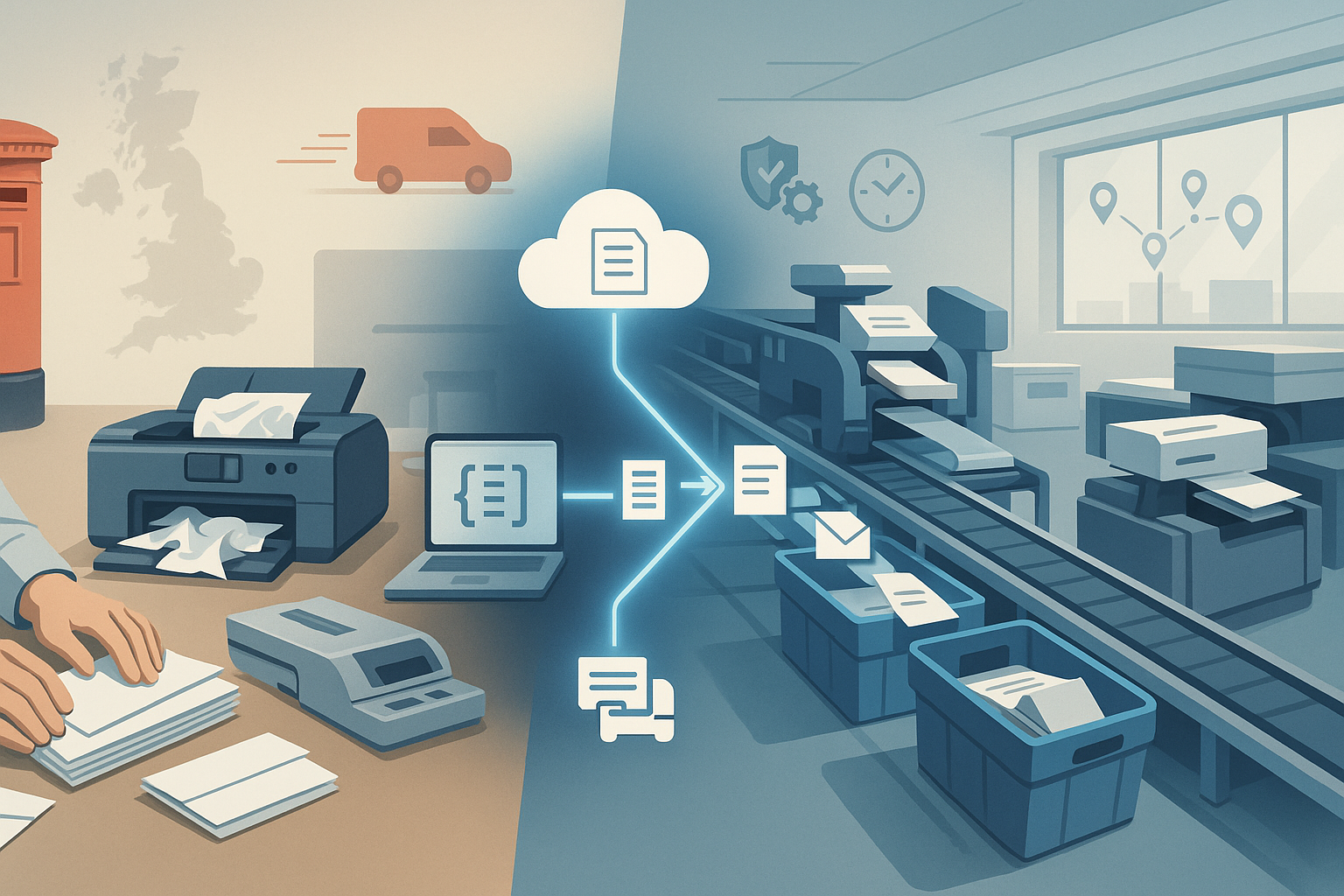
If you send business mail at any real volume — invoices, statements, notices, customer correspondence — someone in your office is printing, stuffing envelopes, and making trips to the post office. Hybrid mail is the technology that lets you skip all of that, and let a specialist print-and-mail facility do it for you.
The idea is simple: you upload a document digitally — through a web dashboard, an API, a watched folder, or by printing to a virtual printer — and the hybrid mail provider prints it, puts it in an envelope, and hands it to Royal Mail on your behalf. Same-day dispatch is standard with most providers if you submit before an afternoon cutoff.
What hybrid mail replaces
Hybrid mail replaces the entire in-house mail operation: the printer, the envelopes, the franking machine, the trips to the post office, and the person managing it all. For most businesses below enterprise scale, running your own mailroom costs more per letter once you factor in staff time, consumables, machine maintenance, and the opportunity cost of having someone stuff envelopes instead of doing work that grows the business.
It also replaces the slower patterns like PDF-and-email invoicing when your customers need a physical copy (more common than you'd think in legal, healthcare, finance, and public sector), and the painful process of outsourcing to a bureau that charges per-job setup fees and minimum orders.
When hybrid mail makes sense
Hybrid mail earns its place when any of the following is true for your business:
- You send more than ~20 business letters a month and someone in your team does it manually.
- You operate in a regulated sector (legal, healthcare, finance, property, public sector) where physical mail is either required or still expected.
- Your invoicing, statement, or notice workflow would benefit from automation — for instance, triggering a letter from your accounting software when an invoice is issued.
- You're a multi-site business and each site currently runs its own local mailroom.
- You want a single audit trail of every piece of mail leaving the business — who sent it, when, to whom.
When it doesn't
Hybrid mail isn't the right fit for every situation. If you send a handful of letters a month, the operational overhead of setting it up exceeds the benefit — stick with stamps and envelopes. If your mail is highly specialised (oversized, non-standard finishes, complex inserts) you may still need a traditional print bureau. And if you're sending physical marketing campaigns where creative finishing matters more than speed, a dedicated direct mail agency is usually the better route.
What to look for in a provider
A handful of things worth checking before you commit:
- UK production. If your data is sensitive (GDPR, regulated sectors), find out whether your documents are printed in the UK or routed overseas.
- ISO certifications. ISO 27001 (information security) is table stakes for any provider handling customer data. ISO 9001 and 14001 are good signals of operational maturity.
- No minimums, no contracts. Good providers charge per piece, not by subscription or volume commitment. Your mail volumes will vary; the pricing should too.
- How you submit. Dashboard upload works for ad-hoc. API integration works for triggered mail from your own systems. Print driver works for teams who don't want to change their tools. A good provider offers all three.
- Same-day turnaround. The whole point of hybrid mail is removing delay. Providers should print and post the same day if you submit before an afternoon cutoff (typically 3pm).
If you're looking to see what your own numbers would be, the Intelliprint savings calculator takes a few minutes to run and compares your current in-house mail costs against hybrid mail pricing. Most businesses sending 100+ letters a month are surprised by the gap.